
Warzone Bottleneck Calculator for FPS, VRAM, and Upgrade Decisions
Check whether Warzone is really being held back by your GPU, your CPU, or the rest of the system before you buy the wrong part. Use the bottleneck calculator on the homepage to check your build, then use this Warzone bottleneck calculator page to read whether your result points more toward heavy graphics load, weak VRAM or RAM headroom, or a real CPU limit that still shows up after the render load drops.
Warzone is easier to misread than lighter shooters because the load is heavier. One build can look strong enough on paper and still feel bad once texture load rises, the visual setup gets heavier, or the system starts struggling with memory headroom and streaming pressure.
The goal is simple: understand what is really blocking your Warzone FPS target before you keep changing settings or spend money on the wrong upgrade.
What a Warzone Bottleneck Result Should Tell You First
A Warzone result is useful only if it tells you what is actually stopping the build from holding the FPS target you care about. The first question is not which part looks weaker in a parts list. The first question is whether the current setup can stay stable enough for the Warzone settings, resolution, and match feel you really want.
That matters because Warzone can punish the wrong setup fast. A build may look acceptable in one quick test and then feel much less balanced once the visual load rises, the session gets heavier, or memory headroom becomes tighter. If the goal is modest, some systems can still feel acceptable. If the goal is higher and the visual setup stays heavy, smaller weaknesses become much easier to notice.
GPU pressure
The graphics card is carrying more load than it can hold cleanly for the current target.
CPU pressure
Lower render load does not help enough, which suggests the processor side is setting the pace.
RAM or VRAM pressure
The game feels heavier than the CPU and GPU names first suggest because memory headroom is too tight.
System-side pressure
Thermals, background apps, storage behavior, or a noisy test setup are bending the answer.
Read a Warzone result against the FPS target, the resolution, and the visual load you actually use. A setup that looks fine in one condition can feel much less balanced in another.
Why Warzone Usually Leans Heavier on GPU Load Than the Other Game Pages in This Cluster
Warzone needs its own page because it does not behave like the cleaner esports pages in this cluster. In the local calculator logic for this site, Warzone is treated as a heavier profile with the note: GPU-heavy with large texture and map streaming.
That local note matters because it explains why so many users blame the wrong part. A player may assume the CPU must be the main problem because the game feels heavy, but the stronger read can still be the graphics side, memory headroom, or the overall load created by a more demanding setup.
This is the cleanest boundary between Warzone and the existing game pages. Valorant stays closer to a lighter high-refresh CPU read. CS2 owns the real-round stability angle. Fortnite owns the mixed CPU and GPU read that changes with scene complexity. Warzone owns the heavier GPU-side and memory-sensitive read where texture load and streaming pressure matter more.
Which FPS Target Changes the Answer Most in Warzone
The same PC can look balanced at one Warzone target and clearly limited at another. That is why the result should always be read against the exact FPS goal you want, not against a vague idea of good performance.
| Target | What Usually Changes First | What To Watch | Best First Read |
|---|---|---|---|
| 120 FPS | Many decent mid-range systems can still feel acceptable if the visual setup is sensible and the machine is clean. | Whether the miss is obvious across the whole session or shows up once the load gets heavier. | Separate a truly weak GPU-side result from a system distorted by memory pressure or background noise. |
| 144 FPS | The answer often becomes much clearer between graphics-side pressure and memory-side pressure. | Whether the player is unwilling to cut the visual load much and whether the system still misses the target. | Use 144 FPS as a practical diagnostic point because it exposes real weakness without being as extreme as 240 FPS. |
| 240 FPS | Weak frame delivery, VRAM headroom, and unstable background behavior become much easier to feel. | Whether the build still feels clean once the margin for error becomes much smaller. | Treat this as a separate goal, not as a bigger version of 120 FPS. |
120 FPS target
This is often where users first separate a truly weak graphics-side result from a setup distorted by memory pressure or background noise.
144 FPS target
This is where many systems start exposing a much clearer answer if the player still wants higher visual quality.
240 FPS target
Very small weaknesses in frame delivery, VRAM headroom, or system noise become much easier to feel.
When Warzone Is More Likely GPU-Limited
Warzone is more likely GPU-limited when the system responds clearly after you cut the render load. This is the first place many users should look because the local Warzone profile already leans heavier on the graphics side than the lighter game pages in the cluster.
One strong sign is simple: you lower resolution or reduce the settings that mostly affect render load, and the game moves in the right direction fast enough to notice. When that happens, the graphics card is doing more of the limiting than the first broad bottleneck label may have suggested.
- The target is being tested at higher resolution.
- The visual setup stays heavy instead of stripped down.
- The graphics card is already working close to its limit.
- Lower render load creates a clear FPS gain.
- Cutting heavier visual settings improves both average FPS and match feel.
- The processor already looks strong enough, but the session still will not hold the target.
This is the pattern where the GPU bottleneck calculator becomes the stronger next page, not the CPU page. If the game keeps responding the right way after deliberate visual cuts, the graphics side is giving you a clearer answer than the processor side.
When Warzone Is More Likely Limited by RAM or VRAM Headroom
Warzone should not be treated like a GPU-only diagnosis because memory pressure can bend the answer too. In the local profile for this site, Warzone already carries extra RAM pressure and a higher VRAM need than the lighter game pages. That does not replace the dedicated RAM bottleneck calculator, but it does change how this page should read the result.
The common mistake is to see a heavy session and blame only the graphics card. That is not always enough. Some systems feel worse because the GPU is under pressure and the memory side has too little room left. In that case, the game can look heavier than the CPU and GPU names first suggest.
- The game feels rough even though the parts list looks decent on paper.
- The result changes too much across longer tests.
- Texture-heavy choices seem to make the session worse faster than expected.
- The system feels heavier than a simple GPU-only limit should feel.
- Stutter matters more than the headline FPS number.
The practical rule is simple: if Warzone still feels heavier than it should after sensible visual cuts, check whether memory headroom belongs on the shortlist before you spend money on the wrong major part.
When Warzone Is More Likely CPU-Limited Instead
Warzone can still be CPU-limited in the right conditions. The mistake is assuming that the GPU-heavy profile means the processor never becomes the real wall. That is not a safe read, especially if the player lowers the render load and still does not get the improvement that should have followed.
The CPU side deserves more attention when the build is being tested at lighter render load, the target is still high, and the result barely changes after the graphics burden drops. That is the point where the processor side starts looking more like the pace-setter than the graphics card.
- The resolution and settings have already been lowered enough to ease the GPU.
- The target FPS is still too high for the current processor side.
- Lower render load does not create enough improvement.
- The session still misses the target badly after sane visual cuts.
- The machine feels noisy from background load, thermals, or sustained clock drops.
This is where the CPU bottleneck calculator becomes a better next step than another random round of graphic setting changes.
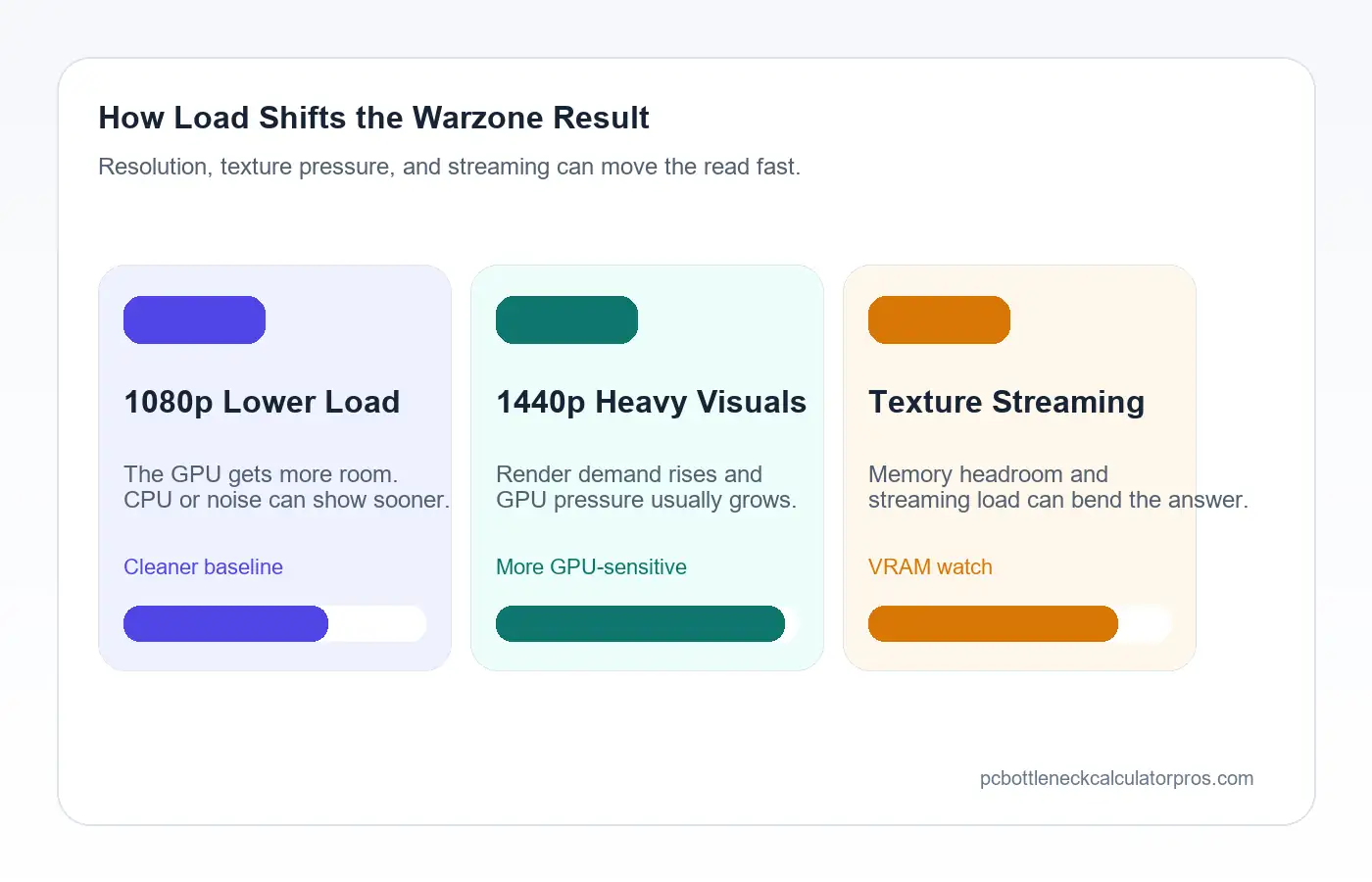
How Resolution, Texture Load, and Map Streaming Change the Result in Warzone
One Warzone result is never complete without context. Resolution, texture load, and how heavy the session feels can all change what the bottleneck seems to mean. That is why this page has to stay tied to repeatable test conditions instead of one random screenshot or one easy moment.
1080p and lower render load
The graphics card gets more room to breathe here, which makes it easier to see whether the GPU was really the problem or whether the CPU side, memory side, or system noise still deserves more attention.
1440p or heavier visual quality
The GPU becomes much more likely to matter, so the same build can shift toward the graphics side once the visual demand rises.
Large texture and map-streaming pressure
The answer can feel heavier than the cleaner sibling pages even when the parts list looks strong enough at first glance.
The practical rule is simple: test one lighter baseline, test one heavier but repeatable session type, keep the FPS target and settings stable, and compare the result before deciding what deserves the blame.
What RAM, Storage, and Background Load Can Distort in Warzone
Not every weak Warzone result starts with the CPU or GPU pairing itself. Sometimes the system looks worse because the rest of the machine is adding noise to the test. That matters here because Warzone already sits in a heavier local profile where memory and streaming pressure can bend the answer more easily.
RAM is one of the first places to check. If the memory setup is weak for the target, the game may feel less stable than the processor and graphics card should suggest. Storage behavior also deserves more attention here than it does on the lighter game pages because the local profile already points to larger map-streaming sensitivity.
The same goes for background load. Browsers, overlays, recorders, launchers, and update tools can all make Warzone feel rougher during the exact kind of heavier test where users are trying to figure out whether the GPU, CPU, or memory side is the true problem. For portable systems, run a laptop-focused follow-up only when heat or sustained power behavior is clearly bending the result.
What To Fix Before Buying New Parts for Warzone
Many users jump to hardware too early. That is expensive when the real problem is still hidden inside the settings, the memory headroom, or the test environment itself. Before you spend money, make the current system prove what it can and cannot do in Warzone.
Lower the right settings first
If reducing the heavier visual load creates a real gain, the graphics side deserves more attention. If the result barely moves, the CPU side, memory side, or system side becomes a stronger suspect.
Check memory headroom before blaming only the GPU
Warzone can feel worse than a simple GPU-only problem when memory headroom is too tight, so check RAM and VRAM pressure before spending big on the wrong part.
Clean up background load and overlays
Close browsers, overlays, recorders, and unnecessary background tools before you trust a bottleneck read.
Check storage, thermals, and sustained behavior
If heat, sustained clock loss, or messy storage behavior is making the session worse, the bottleneck label may blame the wrong part.
Before you buy new parts for Warzone, make sure the current test is clean, repeatable, and stable.
Which Upgrade Path Makes the Most Sense for Warzone
The right upgrade depends on what the system fails to hold, not on which part has the louder reputation online. Warzone often leans heavier on the GPU side than the cleaner sibling pages, but that still does not mean every build should upgrade the graphics card first.
GPU-first cases
A GPU-first upgrade makes more sense when the result improves clearly after you lower the render load and the system is still being tested at settings or resolution that push the graphics card hard.
RAM or VRAM-first cases
A memory-first fix deserves more attention when the session feels heavier than the parts list first suggests, the result changes too much across retests, or the game still feels rough after sensible visual cuts.
CPU-first cases
A CPU-first path makes more sense when the render load has already been reduced enough, the result still does not climb properly, and the processor side looks more like the pace-setter than the graphics card.
When not to upgrade yet
Wait if the system has not been checked with cleaner settings, lighter background load, stable thermals, and one repeatable test path.
That is also when the broader gaming bottleneck calculator becomes more useful than another blind hardware guess.
How To Test a Warzone Bottleneck Properly
The cleanest Warzone test is boring on purpose. You want one repeatable setup, one clear FPS target, and one change at a time. That gives you a result you can actually use instead of a stack of random screenshots that all say different things.
- Pick the target first: 120 FPS, 144 FPS, or 240 FPS.
- Use one repeatable match scenario instead of random moments.
- Record average FPS, 1% lows, and how the session feels under the same load.
- Change one condition only, such as resolution or one group of heavier settings.
- Compare the new result against the first run before making another change.
For most users, the most useful pattern is one lighter baseline test, one heavier but repeatable test, one lower-render-load retest, and one cleaned-up background-load retest. If the same limit keeps surviving those checks, the diagnosis becomes much stronger.
Keep the test conditions stable. Do not change the target, the settings, the background load, and the session type all at once.
Frequently Asked Questions
Is Warzone more CPU-bound or GPU-bound?
Warzone is often more GPU-heavy than the lighter game pages in this cluster, but the right answer still depends on your target, resolution, and visual load. If lower render load creates a clear gain, the GPU side is usually stronger. If that change barely helps, the CPU side or system side deserves more attention.
Can VRAM cause Warzone stutter or bottleneck-like behavior?
It can be part of the answer. This page should not pretend every rough Warzone session is a pure CPU or GPU story. If the game feels heavier than the parts list first suggests, memory headroom can belong on the checklist before you make a major upgrade decision.
Does lowering graphics always fix Warzone FPS?
No. Lowering the render load helps mainly when the graphics side is doing most of the limiting. If those changes barely move the result, the CPU side, memory side, or general system noise may be setting the pace instead.
Can RAM or storage affect a Warzone bottleneck result?
Yes, they can distort the read. This is especially important when the result changes too much between runs or the session feels rougher than the obvious parts pairing first suggests. That does not make RAM or storage the answer every time, but it does make them worth checking before you buy the wrong part.
Should I upgrade GPU or CPU first for Warzone?
Upgrade the part that still limits the system after clean testing, not the part that gets blamed first online. In many Warzone cases the GPU side deserves earlier attention, but lighter retests, memory checks, and system cleanup still need to happen before that decision is trusted.
Conclusion
A Warzone bottleneck calculator result is most useful when you judge it by the real load you use, not by one generic assumption. A heavy Warzone setup can lean harder on the GPU side than the other game pages in this cluster, but memory headroom, system noise, and the actual FPS target can still change the answer.
That is why the cleanest path is simple. Test one repeatable scenario, reduce one condition at a time, and watch whether the result changes because of render load, because of memory pressure, or because the CPU side still cannot carry the target after the GPU burden drops.
Once that pattern stays consistent, the right upgrade path becomes much easier to trust.